
How to Choose the Right Borewell Point on Your Plot
· Amarapali Drillers
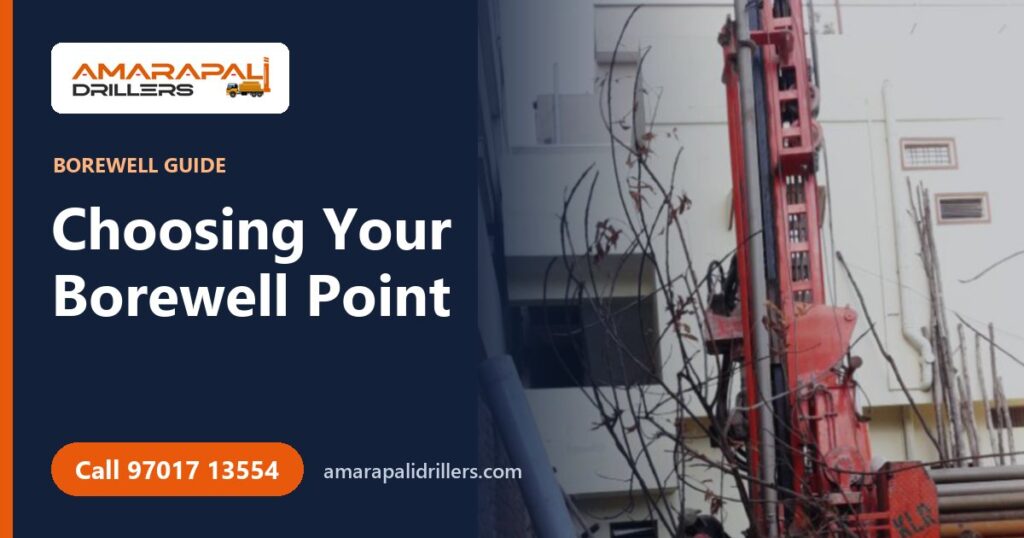
Once the rig starts, the point cannot be moved without paying for a second bore. That makes borewell point selection the most important decision you take before drilling day. It has two sides. One is practical: where a bore can sensibly be placed on your plot. The other is the harder question of where water is more likely. This article deals with both, honestly.
Start with the practical limits
Before anyone talks about water, rule out the places where a bore should not go. On most city plots this removes a large part of the choice.
- Rig reach. The rig must be able to drive up and stand at the point, with open sky above for the mast.
- Overhead wires. Stay clear of electric lines. The raised mast and live wires must never come near each other.
- Underground lines. Avoid water mains, drainage pipes and buried cables.
- The building. Keep away from footings, columns and the compound wall foundation.
- Pump access. Some day the pump will have to be pulled out. There must be clear space above the bore for that.
Keep away from sources of contamination
A bore that is close to a septic tank, soak pit or open drain is at risk of drawing in dirty water, especially through the upper, weathered part of the ground. Place the bore as far from these as your plot allows, and on the higher side of them if the plot slopes. If you are still at the planning stage, decide the bore and the septic tank positions together and put them at opposite ends.
Whatever the point, get the water tested at a laboratory before you drink it. Distance reduces risk. It does not prove the water is safe.
Ways people look for water
There are three common approaches. None can guarantee water in Hyderabad’s granite, where water sits in weathered rock and narrow fractures and results differ from plot to plot.
| Method | What it is | What to expect |
|---|---|---|
| Groundwater survey | A hydrogeologist uses instruments, commonly electrical resistivity, to study the ground | A reasoned recommendation that can improve the odds, not a promise |
| Traditional water divining | A local diviner walks the plot with a coconut, sticks or rods | Widely used and trusted by many, but without scientific proof |
| Local knowledge | Depth and yield of nearby bores, old open wells, how the land lies | Useful background, but a neighbour’s bore does not predict yours |
Which of these you rely on is your choice. If you want a survey, engage a qualified hydrogeologist separately. Where a plot calls for a detailed survey, we will tell you so before the rig moves.
Reading your own plot
A few minutes of observation can help you choose between two otherwise equal points.
- Notice the natural slope and where rainwater collects or flows.
- Ask older residents about any old open well on or near the plot, and whether it held water.
- Look at where existing bores in the lane are placed and how they perform in summer.
- Be careful with ground that has been filled up recently. It may need more casing.
Take these as hints. They shift the odds a little. They do not settle the matter.
Think about the building that is coming
The best time to choose a point is before construction, when the whole plot is open. This is the situation for many owners in newer layouts, such as those asking about borewell drilling in Bachupally or borewell drilling in Boduppal. Bring your building plan to the site and check the point against it.
- The bore should fall in an open setback or parking area, not inside a room.
- It should not sit under a staircase, a beam or a low slab.
- It should be close enough to the sump and the electrical board to keep pipe and cable runs short.
- It should remain reachable by a vehicle after the compound wall and gate are built.
Mark the final point with a peg and show it on the plan, so the builder does not cover it later.
How we help with the point
Helping you choose and mark the drilling point is part of our service. Our advice comes from site experience since 1993: where the rig can stand safely, what to keep away from and what we have seen work on similar plots. It is practical guidance, not a guarantee of water. The rest of what we do is on the services page.
To have your plot looked at, call 97017 13554 or send photos on WhatsApp, and ask for today’s per-foot rate while you are at it. You can also reach us through the contact page.
Planning a borewell?
Call or WhatsApp Amarapali Drillers for today’s per-foot rate anywhere in Hyderabad and Secunderabad.
Get a free borewell quote
Tell us your area and we will call you back with today’s per-foot rate.