
Borewell Casing Pipe Explained: Why It Matters and How Much You Need
· Amarapali Drillers
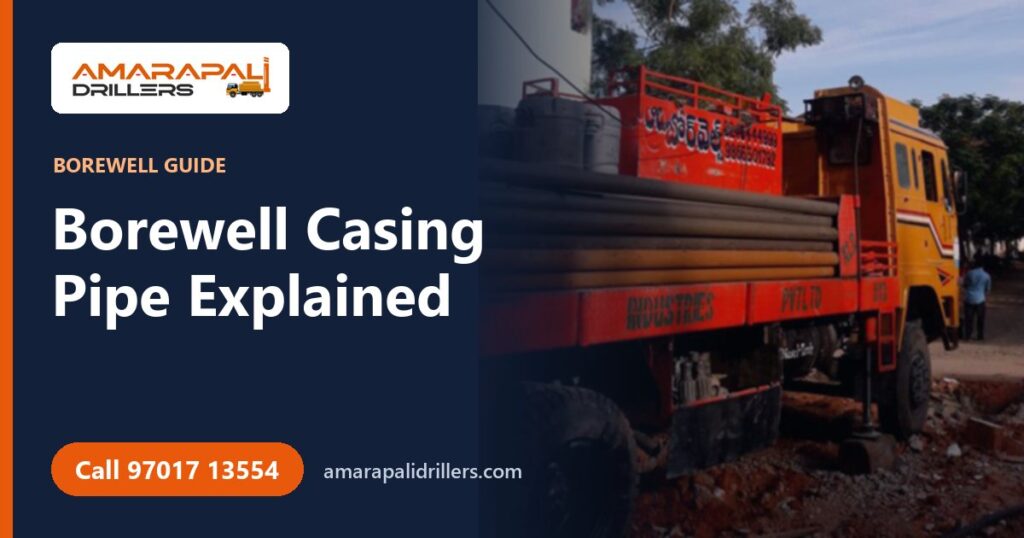
Most people planning a bore think about depth and water. Few think about the borewell casing pipe until it appears as a separate line on the bill. Yet casing is what keeps the bore open and clean for years after the rig has gone. It deserves a few minutes of your attention before drilling day.
What casing does
The top part of any bore passes through soil and soft, weathered rock. This material is loose. Left unsupported, it crumbles into the hole. Casing is a pipe lowered into this top section to hold it back. It does three jobs:
- Stops collapse. Without it, soil and stones fall in and can choke the bore or trap the pump.
- Keeps surface water out. A properly seated casing helps stop dirty water near the surface, such as drain seepage, from running down into the bore.
- Protects the pump and pipes. The pump is lowered and lifted through a smooth pipe and not through rough, crumbling ground.
Where casing goes and where it does not
Casing is fitted only as far as the ground needs support. Once the drill reaches firm, hard rock, the hole stands up by itself, and the rest of the bore is left as open rock. That open section is where water enters through fractures, so it has to stay open.
The casing is taken a little way into the hard rock so that it sits firmly and the joint between loose ground and rock is covered. Occasionally a soft or broken zone turns up deeper down. If that happens, your driller will explain the options on the spot.
How much casing you need
The length depends on one thing: how deep the loose soil and weathered rock run at your exact drilling point. That cannot be measured from the surface. The driller judges it while drilling, from the cuttings coming up and from the way the hammer behaves when it meets solid rock.
This depth changes over short distances. A plot on a rocky rise may reach hard rock quickly. A plot on low or filled-up ground may have a much longer soft section. Newer layouts on the edges of the city, where land has been levelled for plots, can be mixed in this way, and we see it in enquiries for borewell drilling in Nizampet as much as for borewell drilling in Hayathnagar.
So no driller can tell you the exact casing length beforehand. A driller who has worked near your plot can give a rough idea, but treat it as rough. What you can ask for is to be shown the casing pipes before they go in, and to have the installed length counted in front of you.
Pipe types and what to ask
PVC casing is widely used for domestic bores. Steel casing is used on some jobs. Pipes also come in different wall thicknesses and grades, and the price differs with each. Casing is charged per foot, separately from drilling, so know what is being quoted.
| Ask your driller | Why it matters |
|---|---|
| Which casing pipe is in the quote? | Material and grade change the per-foot rate |
| Does the pipe size match my bore? | 4.5 inch and 6.5 inch bores take different pipe |
| Will the casing go into hard rock? | A casing that stops in soft ground can leak soil |
| How will the length be shown to me? | You pay per foot installed |
Where people go wrong
The costly mistake is trying to save money by fitting less casing than the ground needs. A short casing may look fine on drilling day. Later the unsupported section can give way, the water turns muddy and the pump can get stuck. Fixing that is far harder than doing it properly once.
The other common mistake is at the top. The casing should stand clear above ground level and be closed with a proper cap. A casing cut flush with the ground lets rainwater, mud and worse run straight in, and an open bore is a danger to children. Keep it raised and capped from the first day, even before the pump is fitted.
Casing pipe installation is part of our work on every bore, along with drilling, flushing and pump fitting. You can see the full list on our services page.
For today’s per-foot rate for drilling and for casing, call Amarapali Drillers on 97017 13554 or send a WhatsApp message. You can also write to us from the contact page.
Planning a borewell?
Call or WhatsApp Amarapali Drillers for today’s per-foot rate anywhere in Hyderabad and Secunderabad.
Get a free borewell quote
Tell us your area and we will call you back with today’s per-foot rate.