
What Happens on Drilling Day: A Step-by-Step Walkthrough
· Amarapali Drillers
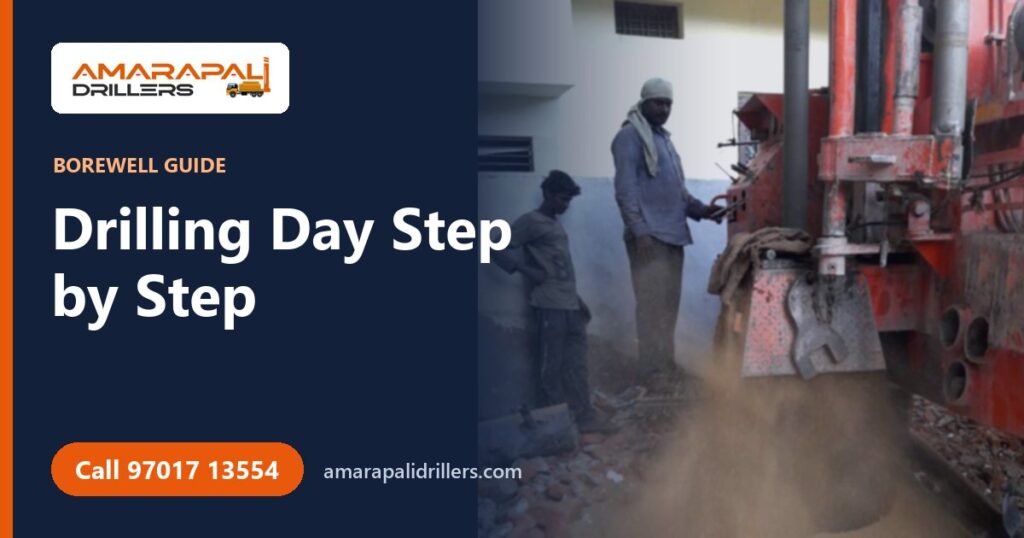
For most families, drilling a bore is a once-in-many-years event, and the day itself can feel chaotic if you do not know what to expect. The borewell drilling process follows the same order on nearly every site. Knowing that order lets you watch the right things and take your decisions calmly.
Before the rig arrives
A little preparation the day before makes everything smoother.
- Have the drilling point marked and agreed. If permission is needed from your local office, have it in hand.
- Clear the approach. Ask neighbours to move parked vehicles, and trim branches that hang over the gate.
- Tell the neighbours. Drilling is loud and throws out dust and slurry.
- Decide your budget depth and who will be at the site to give instructions.
- Cover or move anything near the point that you do not want coated in rock dust.
- Keep children and pets indoors and away from the work area throughout.
In older colonies with tight lanes, which we know well from borewell drilling in Kothapet around our own base, the approach is often the hardest part of the day. Sending us photos of the lane beforehand helps.
Setting up the rig
The rig is a lorry carrying a mast, drill rods and the drilling gear, and it usually arrives with a support vehicle. The crew reverses it up to the point, levels it on jacks and raises the mast until it stands upright over the mark. Hoses are connected to the air compressor.
Before drilling begins, ask the crew to show you the length of one drill rod. You will be counting rods later to know the depth.
Drilling, stage by stage
- Through soil and soft rock. The bit starts at the surface and goes down through soil and weathered rock. Progress here is usually quick.
- Casing goes in. When the bit reaches firm rock, the rods are pulled out and casing pipe is lowered into the soft section so that it cannot collapse. The casing is seated into the rock.
- Into hard rock. Drilling continues inside the casing with a hammer that is driven by compressed air and breaks the granite at the bottom of the hole. The same air blows the broken rock up and out as dust and chips.
- Adding rods. Each time a rod has gone fully down, drilling pauses, another rod is screwed on and work resumes. Count these.
- Watching for water. While the rock is dry, grey dust blows out. When the bit crosses a fracture with water, the dust turns damp and then water sprays out with the air. The crew will call out when this happens.
- Stop or continue. At your budget depth, or when the water looks sufficient, the driller will advise and you decide.
Hyderabad’s rock is hard granite and gneiss, and water is found only where the bore meets weathered rock or fractures. Some bores show water early and some go a long way through dry rock. A few stay dry. Nobody can promise the result in advance, which is why your stop-or-continue decision matters so much.
Flushing and the yield check
When drilling stops, the crew flushes the bore with compressed air for a while to clear out the remaining dust and cuttings. The water coming out starts muddy and should run cleaner as flushing goes on. The flow during this stage gives a working idea of the yield, which is what you need for choosing the pump later.
On an apartment site the same steps apply, with more people watching. For jobs such as borewell drilling in Kondapur, we ask the association to send one person who can speak for everyone at this stage.
Before the rig leaves
- Count the rods as they come out and confirm the total depth with the crew.
- Confirm the length of casing installed.
- Note the depths at which water was struck. Write them down.
- See that the casing stands above ground and is closed with a cap. Never leave a bore open, even for a night.
- Check the bill against the depth slabs and the casing rate you agreed.
The site will be muddy. Slurry and rock dust dry into a hard crust, so clear them within a day or two. The pump and motor are fitted afterwards, once the right size has been worked out.
Drilling, casing, flushing, the yield check and pump fitting are all part of our work, as set out on the services page.
To fix a date, call Amarapali Drillers on 97017 13554 or message us on WhatsApp for today’s per-foot rate. You can also send your details through the contact page.
Planning a borewell?
Call or WhatsApp Amarapali Drillers for today’s per-foot rate anywhere in Hyderabad and Secunderabad.
Get a free borewell quote
Tell us your area and we will call you back with today’s per-foot rate.